When film fans last encountered the familiar creative, tactile, visual storytelling approach anchored by the scrappy team from Hillsboro, OR-based Laika and their helmsman, Travis Knight, their relationship with audiences was still small yet mighty, fractured yet no less complete. And still, all in the name of filmmaking truly made by hand, by a real community committed to the medium and its many offshoots, the disciplines which round it. For those animators, in kind with others who know stop-motion is the grittiest form of filmmaking in existence, it was never to flex skills; they proceeded to protect the authority of their work, especially at a time when honest authorship is seemingly under threat by outside interests, a perpetually changing Hollywood, and the threat of AI alienating what animation overall could look like in the immediate future. Laika took the time to answer those concerns and remind moviegoers that real art still has a place on a theater marquee. A seven-year wait for a film like Wildwood, adapted from a novel by Decemberists frontman Colin Meloy and illustrator Carson Ellis, inevitably counts as a substantial rallying cry.
We may now finally push away the misguided yet still well-meaning Missing Link as the studio’s most recent benchmark; not exactly a low point, but a graze under their standard benchmarks. In returning home, and to a grounded reality, we see a return to form, in line with a few great directors after an unexpected weak spot – think Scorsese answering back from the tepidly received New York, New York with Raging Bull; or Knight himself, just months separated from mixed reception with his reimagining of Masters of the Universe (I remain in the minority proclaiming it was above-decent). Both made that space after a mild stumble to return to an elevated luminance befitting their origins.

And when worldbuilding aligns with ambition, it only tightens a director’s grip. Portland is their home, and at long last, they warmly embrace its beauty, quirks, and proximity to nature’s wonder. Within the latter, we find some beats of weirdness might still be too weird for the city, which would make the adjective an aesthetic. Amid bites into a Voodoo Doughnut, or admiring the billboard at Powell’s, the wheels set in motion for Prue McKeel (an uber-expressive Peyton Elizabeth Lee), an adventurous middle-schooler unafraid to wander, same for her free-spirited parents (Maya Erskine, Jake Johnson) who only ask to keep younger sibling Mac at home, and away from certain dangers of the outside world.
She ignores that directive and takes Mac out about town and to a nearby park, with school friend Curtis (Jacob Tremblay, at a loving cross between gauche and cordial) awkwardly hanging alongside. But that poses a serious risk, with the infant suddenly a target for abduction by a murder of crows. Desperation meets frayed logic as the two peers embark on an unplanned hike along a railroad line and into a supposedly impassable forest, the South Wood. Once there, the pair wander on different tangents, investigating locales and their inhabitants, each with a connection to the child. Or, more accurately, to whoever wishes him harm. But most of them do want to help Prue get her sibling back before this romp devolves into all-out war.
However, I’d say the battle had already begun before Knight re-entered the arena. It didn’t seem like much of a territorial concern when his creative vision first rose to a directorial pedigree with 2016’s Kubo and the Two Strings – the studio’s previous high mark as an indie conduit. In the decade since, his leadership now equals a louder, poetic call to action towards creativity as a whole, and a methodology towards the weight of life, healing, grieving, and especially impulse, all as either a benefit or disservice for an individual’s welfare. At least one aspect of our life is shown at risk of being dulled or lost, and the lengths one would take to anchor or re-secure it, even in fleeting moments of denial, can either label us champions or ostracize us from society. We see that duality around Knight’s sterling vision, matched with Prue’s curiosity to mediate against a tragic evil, boosted by an ensemble to clarify her forest pathway, and the visual discernment to hone it closer into focus.
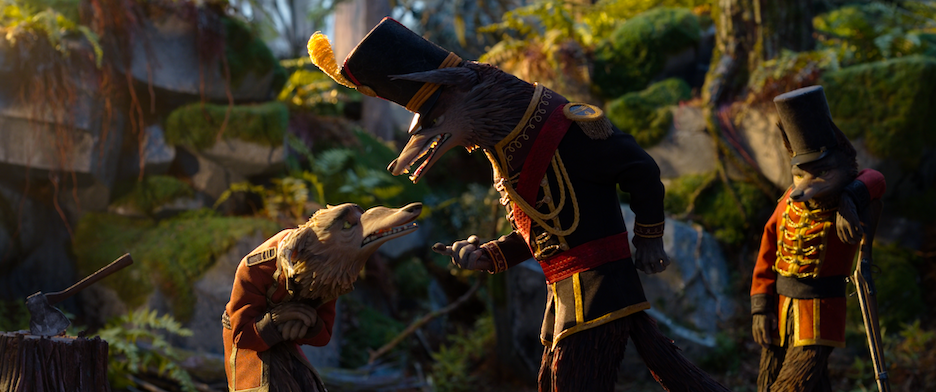
With enough time having spanned since the studio last wowed us, under both mainstream and artful auspices, a fair bit of refamiliarization was inevitably necessary, right before Knight, with regular writing collaborator Chris Butler as co-pilot, proceeds on an alternate wayfinding path, much like he always has; never repeating himself or other creatives. Sources of influence, beyond Meloy’s writing, vary wildly, often flailingly, but keep the atmosphere lovingly centered. The first thing that comes to mind would be Sendak’s spin on Tchaikovsky’s Nutcracker, then Prokofiev, Tolkien, Abercrombie, and the faintest smidgeon of Henson, all tossed in like a plate of carbonara. Spiced last with Butler’s curation and adept faithfulness granting the story its gravitas, its space to provoke, to fly, to be authentic with every action, either violent or tender, always personal with the eccentric people we meet.
And Prue must make quick friends (or at minimum, associates) with a few of them to conquer the wood, all of whom have ties to her brother. It’s only one who wishes for harm. That is Alexandra, the Dowager Governess (a perturbed, iniquitous Carey Mulligan, back to flexing her villain energy), out to settle a score and restore a piece of her lost self, and it involves Mac. And Maxim (an ever-growly and authoritative Tom Waits), leader of her noble coyote army, wastes no time fulfilling her demands. Prue soon takes part as one of a many humble insurgents who will strengthen her quest, and its splendor; headlined by Charlie Day as a rather haughty military reject who might’ve once shared the same drama class with Sam Rockwell’s Bad Guys canid; Mahershala Ali (flawless in his candor), a heavy-muscled bandit anchoring the film’s brand of empathy; Awkwafina, a cantankerous yet intellectual rat with buoyant reflexes; and Angela Bassett (ever the stately bastion of leadership), the top representative of an endlessly vast bird menagerie who’ve assumed a large chunk of the Wood’s square footage.
And the way Knight traverses around the full scope of his set pieces, using his runtime (a brilliant exercise in Miyazaki-style pacing if I’d ever seen one) to best advantage with the breathing room for landscapes to grow, shift, and take control of every situation, anchors every tree, cloud, erected building, grain of dirt, or cobblestone in firmest place. His team of stalwart craftspeople, aided by the electiveness of production designer Nelson Lowry expanding Ellis’s artful concepts beyond basic imagination, remain at the peak of their work, itemizing and layering each element as they all belonged to a living organism. One that sees breaking new ground as a daily accomplishment; not exactly a chore, but a regular circumstance we may give only subconscious thought to.
Once it’s properly staged and captured frame-by-frame with clockwork precision by DP Caleb Deschanel (Never Look Away), grateful to see out of a supposed semi-retirement, the final result is blissful tunnel vision. One cannot simply turn their head for five seconds and expect to stay in focus. It demands your attention to the screen at all times, eyes at rapt attention; and the bigger, the better. Likewise for the ears, with Dario Marienelli’s (Paddington in Peru) eventful, traditional, erudite score mixed with a needle drop or two (one of them an end-credit earworm from Meloy’s band that deserves to clean up on the awards spread) that strives not to unify a particular time, blurring eras while keeping the place close-chested, another reminder of home. And why eventually, the journey back becomes a holistic necessity, with an army behind your back.

That is Laika in this moment; an army of talents infusing their complete professionalism, leaving their hesitation at the door to create something of true worth and unchallenged future-proofing. Knight and his team (who, one hopes, the next project can allow another to take the helm) believe in the power of art the same way one would literature: transformative and affirming. What they’ve done with Wildwood shows the best of animation, and benefits all of cinema, that it remains best when humans lead the way and nimbly explore both what they know and what was once off-limits. That needn’t be the case now; the inaccessible or forbidden forest now feels traversable. Simply because humans willed it, all by hand. (10/10)