


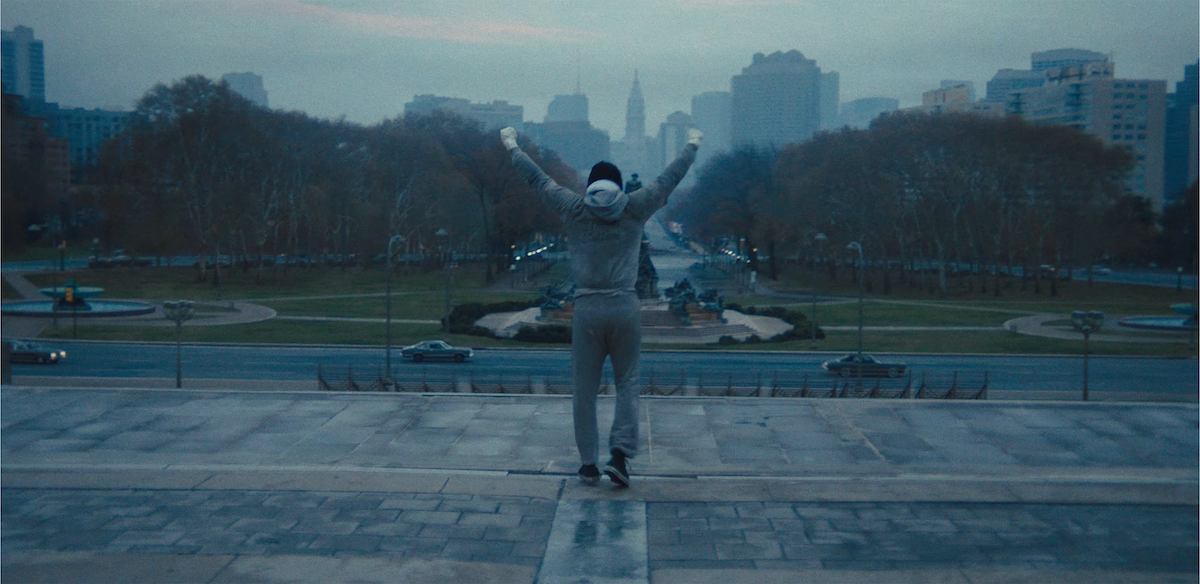
We do not seem to get enough films about filmmakers these days. They’re almost a dying art, lost in the mainstream shuffle. So even when a newer example gets trapped in the retreads, they should be (low-key) celebrated. Peter Farrelly, a director whose resume was built by embracing reusable traits, manages to prove yet again he won’t be defined by them, ready to reinvigorate the mechanics of creativity, and their distinct lack of compromise. That should ring as true as it did in 1975, when Sylvester Stallone (Anthony Ippolito) rose from working-class obscurity to Hollywood legend, set in motion by a lone, unflinching demand: I Play Rocky.
From his early days, living on fragments of paychecks, Sly (early screen alias: Mike Stallone) always knew his worth, an equal balance of passion and profit. He’d string it along with adult roles and minimum-wage jobs. One builds experience, the other relationships. Fellow cinema usher Sasha’s (AnnaSophia Robb) encouragement, and his dad’s (Matt Dillon) logical insistence to make more intelligent career moves prompt the struggling artist to double down on the passion play.
In a whirlwind hurry, Sly and Sasha move to LA to make dreams and connections come true. The strongest of which, with producers Irwin Winkler (P.J. Byrne) and Robert Chartoff (Toby Kebbell), ignites when sneakingly dropping off a spec script outside their office. Time and hardship soon collide, and the up-and-comer begins writing, in desperation, the basis for Rocky after seeing the Shakespearean glory and brutality of boxing on a bar-side TV.


From there, screenwriter Peter Gamble (Office Uprising) has laid out all the pieces for making a movie. We then see the challenge of conquering insurmountable odds, not to mess up, create a slowdown by injury, or go even a dollar or day over. While an admirable display, matched by the thrill of creating something – wildly infectious, in the right hands – it doesn’t entirely replace the value of a personal conflict, which Farrelly makes aware of, though only in the first hour. That mentality is quickly replaced with the joy of “How did they do that?” exploring the hurdles of certain scenes to display the best of Sly’s resilience – and Irwin and Bob’s, by proxy.
Such a behind-the-scenes biopic, without pre-existing source material, can often border on fanfiction if not better reined in. Like how James Franco encapsulated the legend of Tommy Wiseau in The Disaster Artist, only that film used a nonfiction memoir as its starting point for all its churlish behavior, and a well-meaning heart. I Play Rocky, meanwhile, takes a “stream of consciousness” fantasy approach to film history on the page, not always heeding the desire for a more impactful character arc. Granted, yes, Sly’s conquest may inspire, though it won’t feel as grounded or sensible off the bat. Distracted as it is when showcasing the technical marvel and personal uncertainty of capturing his vision (occasionally by accident), it does have to work harder to nail down anything beyond an empty caloric intake, undeservedly.

Farrelly is the key factor keeping this story from devolving further into a self-aware, flavorless parody of the passion play it was destined for. With him, Hollywood business tactics possess real human endeavor. To struggle is to experience the sweetest victory bound to eclipse mere fiction. And that much is believable through a meaty 2+ hours, across every relationship, professional or personal. Byrne’s character actor hit parade in 2026 wraps with a slick, undaunted burst of tastemaker’s authority (re: Coyote vs. Acme and The End of Oak Street for equally substantial cases of his range). Paired with Kebbell, the duo are like a more sympathetic spin on Statler and Waldorf – always critical, ready to throw some stones, but no less discerning on their gut intuition. With their enemy being Tracy Letts (playing the compendium of United Artists’s entire executive pool circa 1975), anything less would’ve made them bend. They make the pushback on Sly’s insistence to play the lead, admissible poison on a film’s bankability, as captivating as that recreation of pure Philly/New York grit, shot by DP Sean Porter with a gleeful keel.
And you can see it all on Ippolito’s face, his body language, and his unending physicality, quite the parallel to Stallone having zero boxing experience. After a mild hesitancy lasting the first twenty minutes, he doesn’t fail to hit the ground running, doing so with quick, heavy steps and harder emotional jabs, making him an ebullient match with Robb, or Jay Duplass’s loving caricature of director John Avildsen, or even Stephan James nailing the gruff mystique of Carl Weathers. None of them should be so effortless in their performances, but the modest bar Farrelly sets atop their heads proves different. And they are all quite efficient, close enough to something remarkable.

Obviously, nothing will surpass the finished product Stallone, Avildsen, Winkler and Chartoff crafted together. We’re not that lucky to consider I Play Rocky the ultimate tell-all of an iconic classic. But to see Farrelly fulfill its goals with favorable results, that is plenty for the subgenre to thrive. That desire for more Hollywood true or tall tales should feel more fervent, though we’d still be an ocean’s trek away from seeing an equivalent George Lucas biopic, for instance. Even when the director contends with mild puttering, every punch it throws benefits its course of action. Plan to account for an extra breather between rounds. (7/10)