


Last year I wrote many long-winded Letterboxd reviews of the Planet of the Apes movies (including TV movies)
And those were all my fourth or fifth time watching any of them. So I feel uniquely qualified to speak on this latest entry to a franchise I’m so endeared to.
To be honest I never had high hopes for Kingdom. Matt Reeves and company ended their trilogy on a high-point, something that had quietly become one of the most consistently solid film trilogies of the 2010s. The franchise is owned by Disney now, and they were getting a YA film director to helm the project. The main positive was that Amanda Silver and Rick Jaffa, writers for Rise of the Planet of the Apes (2011) and wholly responsible for kick-starting this new age of the franchise, were still producing and wanted to take the franchise in their original direction before the 2010s movies deviated with Dawn.
At best, I thought it’d be serviceable and safe, a backdoor for a Disney+ series of some sort.
So imagine my surprise when I found most of this movie captivating and intriguing.
Being the 4th movie in an Apes series isn’t necessarily a bad thing. The 4th movie of the original pentalogy was Conquest, and that was total reinvention of what came before and even gave us the mythical figure of Caesar and his ape uprising that the 2010s trilogy used as their bedrock. This movie attempts to do the same, setting itself “many generations,” after War for the Planet of the Apes and wanting to set up a new world and threads.
Said new threads follow a young chimp named Noa, son of a chieftain to a clan of apes that raise hawks. A chance encounter with a human causes his village to be raided in the name of Proximus Caesar, an aspiring inheritor of this Planet of the Apes (his is the kingdom the movie gets it’s awkward name from.)
Kingdom alternates between a slow pace and rapid blink-and-you’ll-miss-it world-building. There’s a lot of show-don’t-tell and shorthand and that can be a double-edged sword for the movie. We’re only given baseline introductions to many of Noa’s tribe before they’re either killed or carted off by masked raiders, but that doesn’t phase me because Owen Teague’s performance conveys the weight of what they mean to him. When it becomes a movie about him traveling the Valley Beyond (one might call it a Forbidden Zone) the movie slows down and becomes a sort of pilgrimage where he accumulates followers and learns about the world in a very captivating way.

But the movie loses something when one of those followers, a human girl named Mae, speaks. It’s not just that she speaks, it’s that she speaks well, better than the apes, and suddenly it becomes the Mae movie told from Noa’s POV. It feels like she wandered in from her own movie, some sort of Fallout meets Planet of the Apes, and its interrupting my interesting A New Hope Meets Planet of the Apes movie. Once she starts talking she becomes a font of exposition in a way that feels so awkward and clumsy compared to the world-building we got when it was just apes on-screen.
This comes at the expense of the movie’s main villain, Proximus. He’s so close to being a great villain for the franchise, but again, too much of his character is inferred. His introduction is terrific (even if his repeated exclamation of “What a wonderful day!” feels derivative of Fury Road) and Kevin Durand gives him this ego-high performance with crazy eyes, but he feels more an obstacle than a three-dimensional character. There’s an insistence that he’s corrupted Caesar’s legacy, conflated him with the Caesar of human history, but that’s really not explored beyond the shrug of “Caesar wouldn’t want apes to conquer other apes.”

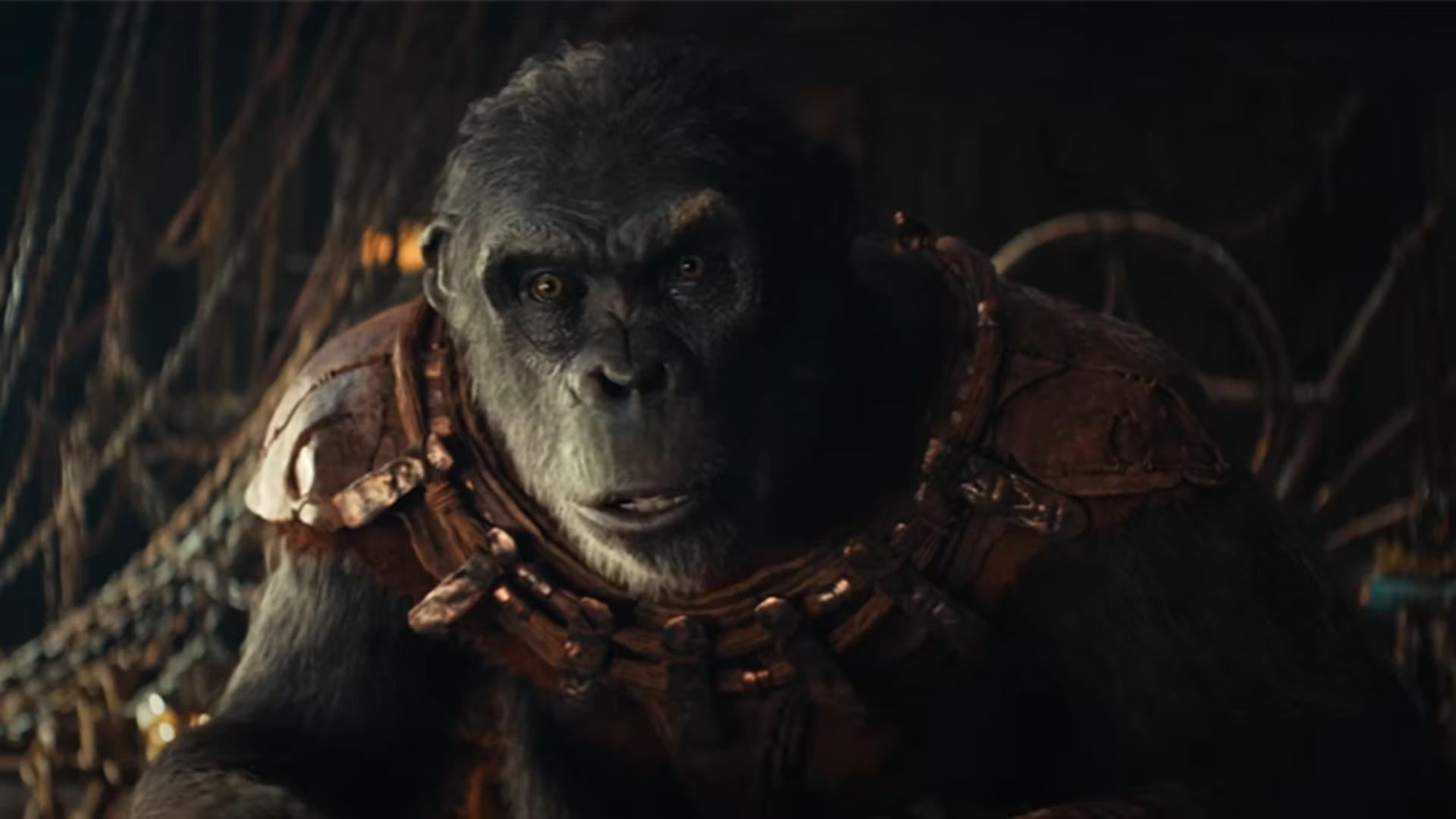
Proximus would probably feel more tangible if the last act of the movie didn’t clearly start signposting that this is the beginning of a fresh trilogy and he ultimately does not matter to said trilogy. The movie was by and large sold on this idea of seeing how the new ape societies retain and twist the story of Caesar to their own means, but that falls by the wayside as it steers back to the franchise’s age old conflict of Ape vs Human. Now, that is the conflict that forms the bedrock of the franchise, but the particular conflict they’re setting up feels too reminiscent of what was already tackled (and tackled well) in Dawn and War, and the setup comes at the cost of this far more interesting idea never done in the franchise outside of the very final moments of Battle for the Planet of the Apes (1973).
In terms of context of the franchise as a whole, I feel it’s actually pretty equivalent to that original fourth film, Conquest of the Planet of the Apes (1972). It promises a new status quo and is verifiably doing it’s own thing, but fumbles the ending because of a lack of confidence.
It’s still a strong film and I have much more hope for future entries than I did prior, but now all the weight is on the next movie to prove whether Kingdom’s last act stumble is temporary, or the prelude to falling flat on its face.